I have spent the past five years building software for the manufacturing industry. For that whole period, there’s been ongoing public discourse about automation in manufacturing, and yet this isn’t something I see in my day-to-day on shop floors.
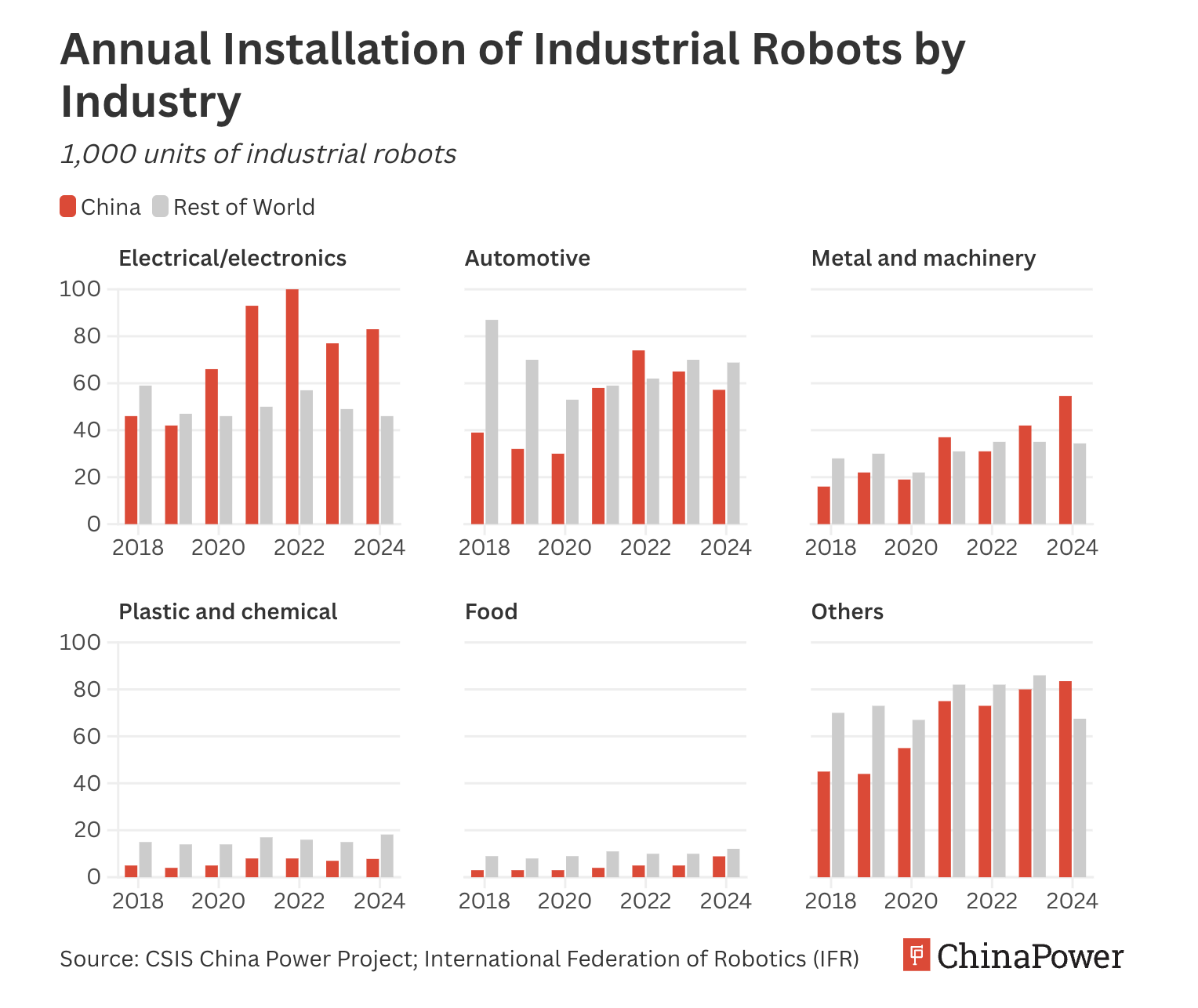
On the other hand, I often hear news about the degree to which Chinese manufacturing is increasingly automated. I think most of us have seen those Reel videos where engineers in China beat up a humanoid robot, only for it to recover and stand up again. I’ve been thinking a lot about where the robots are for western manufacturing, and I’ve come to the conclusion that there are some systemic differences between Chinese and western manufacturing that play into this.
The nature of western manufacturing
Western manufacturers are overwhelmingly engaged in the business of high-mix, low-volume manufacturing. This is a kind of manufacturing where parts are ordered in very small quantities (1-1000 units usually) and the manufacturer builds those parts to order.
Naturally, if you’re ordering fewer parts from the manufacturer, they’re going to make less money. This means that a manufacturer engaged in shorter batches, in general, needs to accept more orders than a manufacturer who does larger batches so as to cover their costs.
When you accept more orders, you are also accepting new requirements, new geometries, and all of the work that goes with it. That work includes:
- Comprehensively understanding customer requirements
- (possibly) Design-for-Manufacture work
- Quoting the part
- Figuring out how to make it (planning)
- Programming the machine
- Producing part routing
- Running First-article inspections
- Getting the production operations scheduled onto machines & staff
None of these tasks are independently complicated, but taken together, with a large number of different geometries and customers, you’re very quickly running into a multi-dimensional scheduling and constraint problem that most shops are simply not set up to handle.
Short batches really suck
Imagine this - you’re at a Quality Control desk on a shop floor. 15 parts have been poured out of a bucket and onto the desk in-front of you.
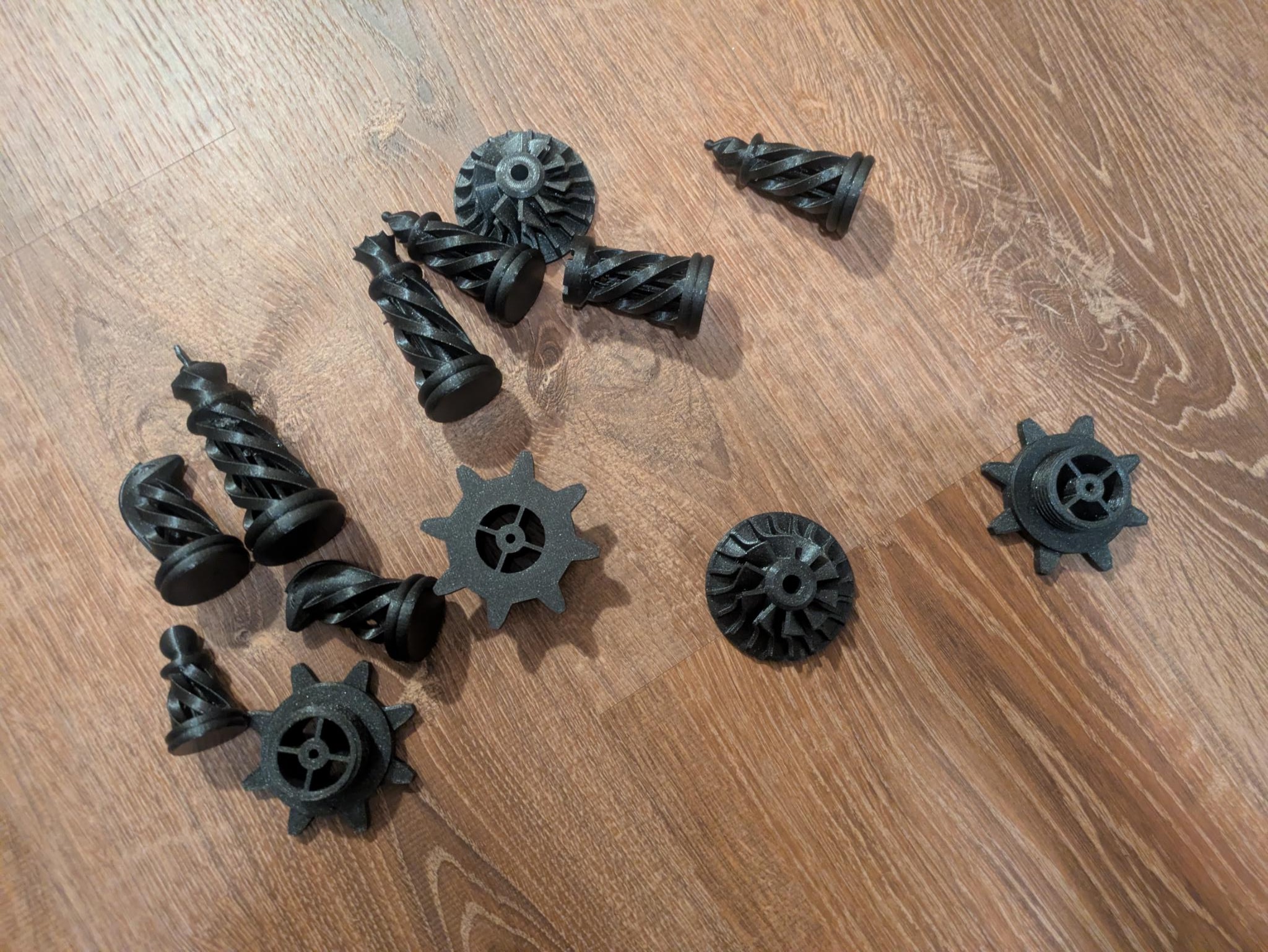
For each part, you need to figure out:
- Which part is this?
- Who is it for? Do I have any special quality checks to do?
- Where does it go next in the workflow?
This is really where short batch manufacturing breaks down. Every part on the table is completely different. Each one could be for a different customer with a different use case. One of the customers might need perfect surface finish, and another might need excellent tensile properties. How are you going to know which part is which?
Strictly speaking, you should refer to your routing documents for each part and check. In practice (especially at high SKU counts) staff are just guessing. It’s simply not viable to look up every single part and refer to the formal documentation.
Over time, this leads to the accumulation of tribal knowledge in a few staff members. They “learn” to recognize the parts. They’ve seen similar parts before and know which customers are working on which projects. They know that this part is for “customer X” and that “3 years ago we underquoted this part and it had a crazy scrap rate that put the entire order into the red”. Put another way, short batches make shops dependent on human pattern-matching, which is exactly what robots can’t replicate yet.
So where are the robots?
Going back to my original premise, the robotic automation we’re hearing about in China is real, but we need to bear in mind that China has an enormous high-volume manufacturing industry, wherein they are making the same parts again and again. Many of the problems I have listed in this article simply don’t apply in high-volume work.
There are really fundamental problems that need to be solved in western manufacturing to make space for automation. The first of which would be automation of the planning. In practice this means some kind of AI system that can tell you how to make this part.
Such a system would solve the quoting and scheduling problem all at once (since quoting is essentially a-priori planning). More importantly, it would pull the tribal knowledge out of people’s heads and into a system - every part, customer requirement, and routing decision captured somewhere that a machine can read it. That context is the thing the staff member at the QC desk has and the robot doesn’t.
With that out of the way, we’d then be able to move onto the next set of problems, which include identifying parts automatically (visually), performing QC using AI models, and eventually, using an end-effector to grab the parts and move them around the shop floor.
What strikes me as crazy is that we have all the individual pieces being worked on. The robotics companies are figuring out how to get artificial hands to pick up objects, the CAD software companies have really robust tool-pathing solutions, computer vision algorithms have come so far, and yet nobody is gluing these solutions together into a complete package.
Is it possible that the Silicon Valley ethos of “do only one thing and do it well” has prevented VC-backed software from truly delivering for western manufacturers?
Does the emergence of AI in software engineering change this?
What topics would you like me to cover in future posts? Feel free to reach out on LinkedIn with your suggestions!